

You stepped on the scale, and the number didn’t move — or worse, it went up. Before you spiral, consider this: that number tells you almost nothing about whether your body is actually changing for the better.
The Problem With Using Weight as Your Only Metric
Weight is seductive as a progress tool because it’s simple. You step on a scale, you get a number, and your brain immediately turns that number into a verdict about whether your efforts are working. The problem is that body weight is one of the most volatile and misleading data points you can track.
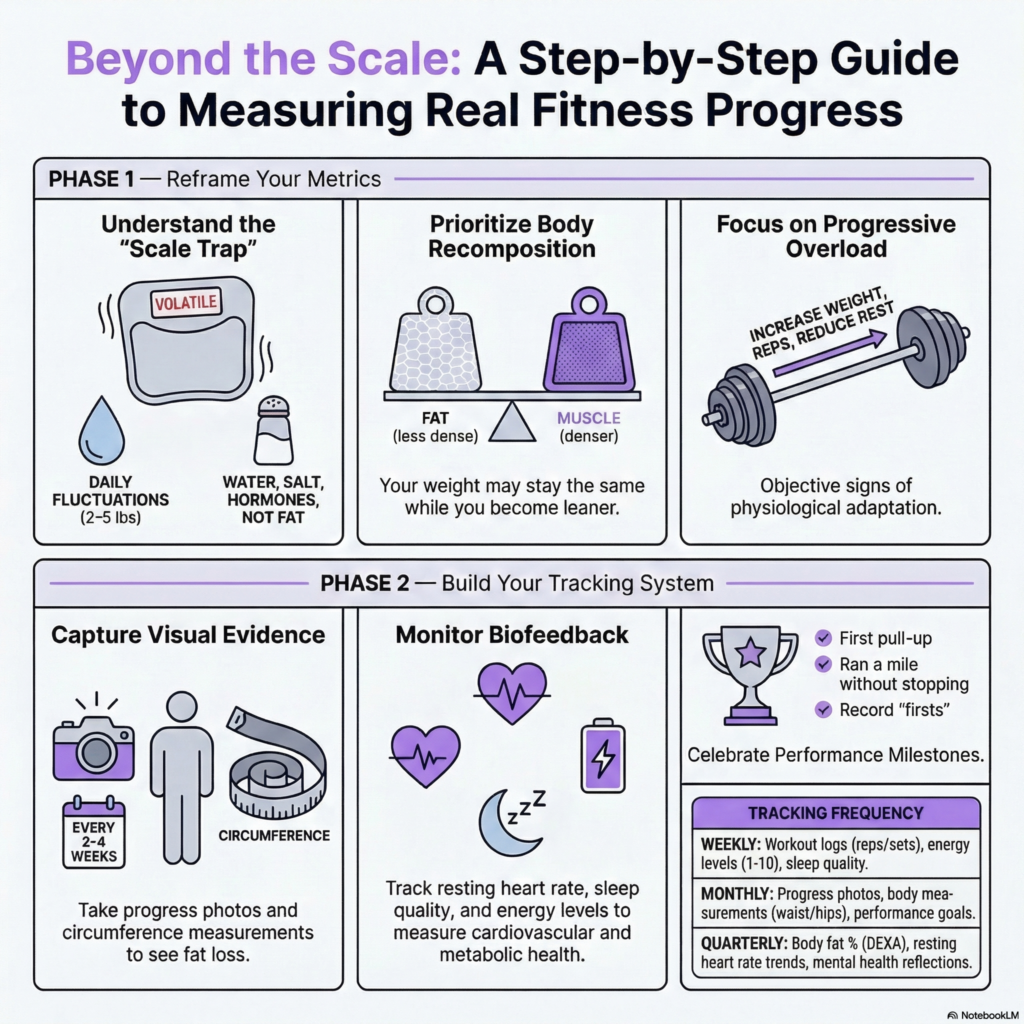
Your weight fluctuates by two to five pounds on any given day, depending on hydration, sodium intake, hormonal cycles, how much food is sitting in your digestive system, and even how much sleep you got the night before. A salty dinner, a rest day, or the week before your period can make the scale read higher without a single ounce of fat being added to your body.
More importantly, when you’re strength training — which you absolutely should be — your body undergoes changes that the scale cannot capture. Muscle is denser than fat. As you build muscle and lose fat simultaneously, your weight can remain unchanged or even increase while your body becomes leaner, stronger, and healthier. This phenomenon, known as body recomposition, happens all the time, especially in people who are new to resistance training or returning after a break.
Relying exclusively on the scale creates a dangerous feedback loop. You work hard, your body changes, but the number doesn’t drop, so you conclude your approach isn’t working. You might cut calories further, overtrain, or quit entirely — all because you trusted the wrong measurement.
The solution isn't to stop tracking. The solution is to track what actually matters.
Strength Gains: The Most Underrated Measure of Progress
If you want one metric that tells you whether your body is genuinely adapting to your training, track your strength. Strength gains are objective, measurable, and directly tied to meaningful physiological changes.
When you get stronger, your neuromuscular system becomes more efficient. Your body is recruiting muscle fibers more effectively, your tendons and ligaments are adapting, and your muscles are growing — or at minimum, being maintained — while your overall body composition improves.
Strength is not just a vanity metric. It’s one of the strongest predictors of long-term health outcomes, including lower risk of cardiovascular disease, improved insulin sensitivity, and reduced all-cause mortality.
Here's how to track it in a way that keeps you motivated:
Log Your Workouts Consistently
Use a notebook or an app to record every set, every rep, and every weight used. This doesn’t have to be complicated. You’re looking for a trend over weeks and months, not perfection in every session.
Watch for Progressive Overload
Progressive overload is the principle of gradually increasing the demand placed on your body over time. This might mean adding five pounds to your squat, completing ten reps when you previously maxed out at eight, or reducing rest time between sets. Any of these counts as measurable progress. When you can see that three months ago you were struggling with 95 pounds on a barbell and now you’re moving 145 with confidence, the scale becomes irrelevant.
Celebrate Performance Milestones
Your first pull-up. Your first bodyweight squat with perfect form. Running a mile without stopping. These performance milestones are genuine achievements that deserve recognition. They reflect real adaptation — changes in your cardiovascular system, your muscle function, and your mental resilience. Write them down. Track them. Celebrate them.
Understanding Body Composition: What You’re Actually Made Of
Your body weight is just one number. Your body composition tells a far more detailed story by breaking that weight into categories: muscle mass, fat mass, bone density, and water weight. Two people can weigh exactly the same and look completely different, feel completely different, and have entirely different health profiles — because their body compositions differ.
Body composition is what you’re really trying to change when you pursue a fitness goal. Here are several practical ways to track it:
Progress Photos
Take photos in the same lighting, same clothing, and same time of day — ideally once every two to four weeks. The human eye can detect changes that the scale will never show you. You might notice your waist looks narrower, your arms look more defined, or your posture has improved. Progress photos are one of the most powerful tools available precisely because they capture what actually matters: how your body looks and moves.
Circumference Measurements
Use a soft tape measure to track key areas: waist, hips, chest, arms, and thighs. Even when scale weight holds steady, losing inches around your waist while gaining measurement in your arms is a clear sign that fat is being lost and muscle is being built. Measure once every two to four weeks for meaningful data.
Body Fat Percentage Tools
Methods such as DEXA scans, hydrostatic weighing, and bioelectrical impedance scales estimate body fat percentage with varying degrees of accuracy. None is perfect, but used consistently over time, they provide directional data. A decrease in body fat percentage alongside stable or increasing weight is the clearest possible sign that body recomposition is happening. If you have access to a DEXA scan every few months, it can be one of the most motivating data points in your entire tracking toolkit.
How Clothes Fit
This one gets dismissed because it sounds unscientific, but it’s genuinely useful data. When your jeans feel looser in the waist and tighter in the thighs, your body is telling you something real about where fat is being lost and muscle is being built. Don’t underestimate the value of this feedback.
Other Metrics That Signal Real Progress
Beyond strength and body composition, there are several other markers worth tracking that provide a comprehensive picture of how your health and fitness are improving.
Resting Heart Rate
A lower resting heart rate is a direct indicator of cardiovascular fitness. As you become more aerobically conditioned, your heart becomes more efficient — pumping more blood per beat and working less hard at rest. Track your resting heart rate first thing in the morning for a clean, consistent measurement. Seeing this number drop from 75 to 62 beats per minute over a few months is meaningful physiological progress.
Energy Levels and Sleep Quality
Ask yourself: Do you have more energy throughout the day? Are you sleeping more soundly? These subjective markers are tied to real improvements in metabolic health, hormonal balance, and physical conditioning. Keep a simple weekly note about how your energy feels and how your sleep has been. Over months, patterns emerge.
Workout Recovery
Pay attention to how quickly you recover between sessions. When you first started training, you may have been sore for four days after leg day. Over time, that soreness might reduce to one day — not because you’re working less hard, but because your body has become more efficient at repairing and adapting. Improved recovery is a sign of a healthier, more resilient body.
Mobility and Flexibility
Can you touch your toes now that you couldn’t three months ago? Is your squat deeper? Is your shoulder press overhead with less discomfort? Mobility improvements reflect real structural and neuromuscular changes that enhance your quality of life and reduce your risk of injury. These changes matter enormously, even if they never show up on a scale.
Mental Health Markers
Consistent training has documented effects on anxiety, depression, confidence, and cognitive function. Tracking how your mental state evolves throughout a fitness journey is neither soft nor irrelevant — it’s central to the picture. A training program that makes you feel stronger, more capable, and less anxious is working, even on the days the scale disagrees.
Building a Multi-Metric Tracking System That Actually Works
The goal isn’t to overwhelm yourself with data. The goal is to build a complete picture so that no single bad weigh-in can derail your progress or your confidence.
Here’s a simple framework to get started:
Track weekly: workout log (weights, reps, sets), energy level rating (1 to 10), and sleep quality rating (1 to 10).
Track every two to four weeks: body weight (once per week, same conditions, and average it), progress photos, circumference measurements, and any new performance milestones reached.
Track every two to three months: body fat percentage if accessible, resting heart rate trend, and a written reflection on how you feel overall.
When you look at this complete picture, the story becomes undeniable. Even when the scale is stubborn, you’ll see you’re lifting more, sleeping better, losing inches, looking better in photos, and feeling stronger. That is progress. Real, meaningful, lasting progress.
In Conclusion
The scale is a tool, not a judge. When you reframe success around what your body can do, how it’s composed, and how it feels — rather than what it weighs — you stop chasing an arbitrary number and start building something real. Strength gains, lost inches, better sleep, and deeper squats are all proof that your work is paying off, even when the scale refuses to cooperate.
If you’re ready to stop measuring yourself by the wrong stick and start tracking progress that actually reflects your hard work, download our free Body Composition Tracking Guide and start building a clearer, more complete picture of your fitness journey today.