Your Best Defense Against Osteoporosis After 40
You’re doing everything “right” — eating well, staying active, managing stress — and yet no one warned you that after 40, your bones start losing density faster than at any other point in your adult life. If you’re in perimenopause or menopause, weight-bearing exercise for bone density isn’t optional anymore. It’s one of the most powerful tools you have to protect yourself from osteoporosis before it ever becomes a diagnosis.
Why Bone Loss Accelerates During Perimenopause (And Why It Matters Now)
Most women don’t think about their bones until something breaks. But here’s what’s happening under the surface: estrogen plays a critical role in maintaining bone density. It slows the activity of osteoclasts — the cells responsible for breaking down bone tissue. When estrogen begins to fluctuate and decline during perimenopause, that protective effect weakens.
The result? Women can lose up to 20% of their bone density in the five to seven years around menopause. That’s not a slow, gradual decline. That’s a significant structural shift happening in a relatively short window of time.
The tricky part is that you can’t feel bone loss. There’s no pain, no warning signal, no obvious symptom screaming at you to pay attention. You might be experiencing hot flashes, brain fog, or disrupted sleep — and completely unaware that your skeleton is quietly becoming more vulnerable.
This is why waiting until you get a concerning DEXA scan result is not the strategy. The time to act on bone health is now, in your 40s and 50s, when you can still build, maintain, and protect what you have.
Osteoporosis isn’t just about fractures either. A hip fracture in older women carries a serious risk of long-term disability. Vertebral compression fractures can change your posture, limit mobility, and reduce your quality of life in ways that affect everything — your career, your confidence, your independence. For the high-achieving woman who refuses to slow down, that’s not an acceptable future.
How Weight-Bearing Exercise Protects and Builds Bone Density
Here’s the good news: your bones respond to stress. In the best possible way.
When you place mechanical load on your skeleton — through impact, resistance, or ground reaction forces — your bones detect that stress and respond by stimulating osteoblasts, the cells that build new bone tissue. This is the foundational science behind weight-bearing exercise for bone density, and it works at every age, including yours.
Weight-bearing exercise falls into two categories:
High-impact activities that involve both feet leaving the ground or significant ground forces — things like walking, jogging, hiking, dancing, tennis, and jumping. These are excellent for bone stimulation, particularly in the hips and spine.
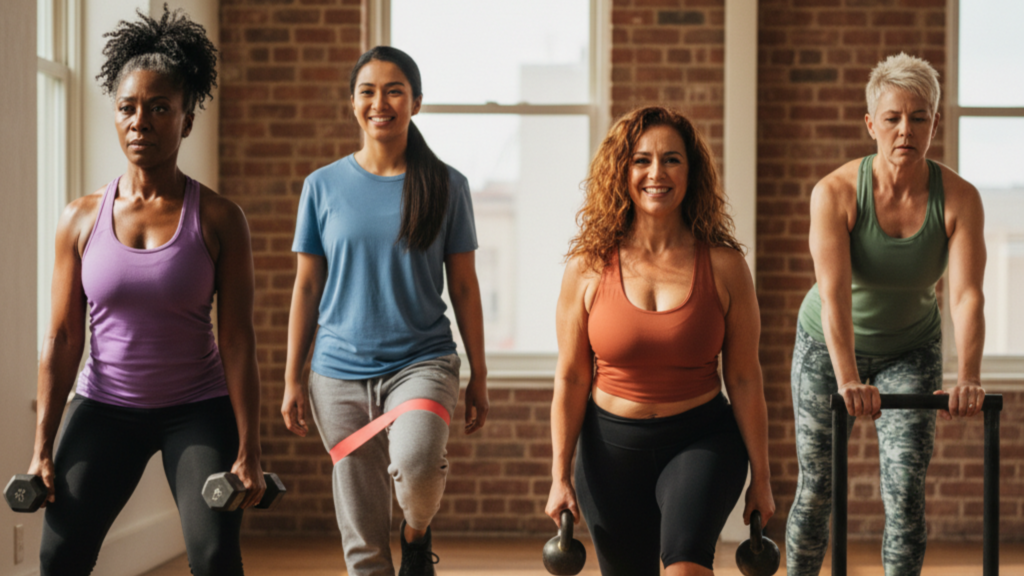
Resistance training (also called strength training or weight training) — lifting weights, using resistance bands, or performing bodyweight exercises that load your muscles and, by extension, your bones. This is especially powerful for building and maintaining bone density in women over 40 because you can progressively increase the load.
The research is detailed on this. A landmark study published in the *Journal of Bone and Mineral Research* found that women who participated in progressive resistance training significantly improved bone density at the hip and spine compared to controls. Another study from the *British Journal of Sports Medicine* confirmed that high-intensity strength training — not gentle walking — produced the most meaningful gains in bone density for postmenopausal women.
What doesn’t help much? Swimming and cycling. Both are excellent for cardiovascular health, but because they’re not weight-bearing, they don’t create the mechanical stress your bones need to remodel and strengthen. If these are your primary forms of exercise right now, they need to be complemented with something more bone-specific.
Functional Training: The Smarter Way to Train for Bone Health in Perimenopause
Functional training — exercises that mimic real-life movement patterns — is particularly valuable for women in perimenopause and menopause. Why? Because it doesn’t just build bone density. It also builds the strength, balance, and coordination that prevent falls that cause fractures in the first place.
Think about it this way: even if your bones are strong, a fall can be dangerous. Functional training addresses both sides of the equation.
Here are the key movements your bone health training program should include:
Squats and Deadlifts
These compound lower-body movements load the hips and spine directly — the two sites most vulnerable to osteoporotic fractures. Start with bodyweight, progress to goblet squats, then barbell or dumbbell variations as strength improves. The goal is progressive overload over time.
Hip Hinge Patterns
Romanian deadlifts, single-leg deadlifts, and kettlebell swings all train the posterior chain while placing direct load on the femoral neck — a primary fracture site in osteoporosis. Even light-to-moderate loads done consistently produce measurable results.
Loaded Carries
Farmer’s carries and suitcase carries challenge grip strength, spine stability, and hip musculature simultaneously. They also train your body under load in a way that directly translates to real life.
Step-Ups and Single-Leg Work
These build hip stability and balance — critical for fall prevention. They also create unilateral load on the hip bones, which responds well to this kind of targeted stress.
Upper Body Pulling and Pressing
Don’t neglect the upper body. Rows, pull-downs, and overhead pressing protect the thoracic spine and shoulder girdle — areas where postural compression fractures can occur with advanced bone loss.
Two to three sessions per week of structured resistance training is the minimum effective dose for bone health. Three to four sessions are the sweet spot for women who are ready to be more proactive. The keyword is progressive — your body adapts to a training stimulus over time, so the load must increase gradually to keep driving bone remodeling.