

3 Surprising Truths About Nutrition and Menopause Women Should Know
Are You Lost in the Fog of Nutritional Advice?
Do you feel like you need a PhD just to figure out what to eat for lunch these days? Navigating health advice during midlife often feels like driving through dense fog without headlights. Between influencers peddling “miracle” powders and headlines that contradict one another, it is exhausting to separate marketing fiction from physiological fact.
You are a professional who manages complex projects and teams, yet keeping your own plate clear has become a source of stress. This constant barrage of conflicting information often leaves intelligent women feeling more confused than empowered about how to best support their bodies through this significant transition.
We will reduce the noise. Instead of a restrictive list of rules, we will explore three evidence-based truths that change how you view your body’s fuel. This is your strategic framework for reclaiming clarity and strength.
Why Modern Advice on Nutrition and Menopause is Failing You
The disconnect between marketing and biology
Most advice treats midlife nutrition as a weight-loss game, focusing solely on calories in versus calories out. However, the biological reality is that your body is undergoing a structural renovation. We need to shift the focus from shrinking your body to supporting the physiological shifts occurring as estrogen declines.
Understanding the unique intersection of nutrition and menopause is about resource allocation. Your body is working harder to maintain baseline functions, and it needs high-quality materials, not just a caloric deficit.
The cost of information overload
Constant conflicting information raises cortisol levels—stress hormones that actually worsen menopausal symptoms like hot flashes and abdominal weight gain. When you are stressed about what to eat, your body perceives a threat.
By simplifying your approach to nutrition and menopause, you lower that stress tax. This provides a clear return on investment for your health efforts, allowing you to focus your energy on your career and family rather than stressing over a salad.
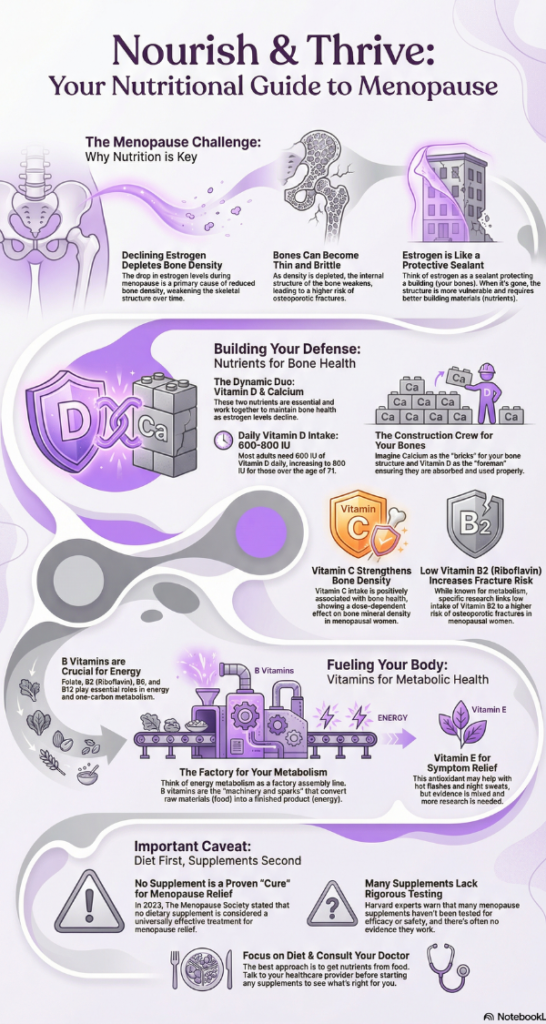
Truth #1: The “Energy” Vitamin That Is Secretly Shielding Your Bones
Beyond the metabolism factory
We typically view B vitamins—such as folate, B6, and B12—as the spark plugs of our energy system. They are well-known for keeping the assembly line moving, converting carbs and fats into fuel. A helpful way to visualize this is to think of the process as a factory assembly line.
If carbohydrates and fats are the raw materials entering the factory, B vitamins act as the essential machinery and sparks that keep the process moving. However, limiting their role to energy production misses a critical piece of the puzzle for women over 40.
The hidden link to fracture risk
Vitamin B2 (Riboflavin) is not just keeping the lights on; it is reinforcing the building’s frame. According to recent research published in the Journal of Bone and Mineral Metabolism (PMC6372850), this vitamin plays a crucial structural role.
Studies indicate that vitamin B2 benefits for women extend to the skeletal system, where low intake is associated with higher fracture risk. The mechanism is compelling: B vitamins help regulate blood homocysteine levels.
When homocysteine levels are too high, they interfere with collagen cross-linking in bone. Think of collagen as the flexible netting inside your bones; if that netting is weak, the bone becomes brittle. Neglecting B2 is akin to ignoring the foundation of your factory while focusing only on production speed.
Truth #2: Your Skeleton is a Construction Site, and It Needs a Foreman
Estrogen: The missing sealant
The link between calcium and bones is well known, but the context changes in midlife. Think of estrogen as the protective sealant on a brick building. For decades, it prevented weathering and erosion.
As that sealant wears off during menopause, the bricks beneath become vulnerable to the elements. Without that hormonal protection, the building becomes much more susceptible to deterioration.
The construction crew hierarchy
To maintain the building without that sealant, you need a precise construction crew. Throwing raw materials at the site isn’t enough; you need management.
Bricks (Calcium): The raw material used to build the structure.
The Foreman (Vitamin D): The manager who ensures bricks are delivered and properly absorbed.
Project Support (Vitamin C): The essential support staff that maintains the collagen matrix.
Why the foreman matters most
Without a good foreman (Vitamin D), the bricks (Calcium) cannot be used effectively. In fact, without Vitamin D, calcium may accumulate in your arteries or kidneys rather than supporting your bone health after 40.
The recommended daily intake for Vitamin D is generally 600 IU for adults, increasing to 800 IU for those over 71. Furthermore, Vitamin C provides essential support for the project; research shows its positive effect on bone mineral density is dose-dependent—meaning higher intake correlates directly with greater benefit.
Truth #3: Why the “Magic Bullet” Supplement Strategy Backfires
The counter-intuitive reality
Given the importance of these nutrients, a targeted supplement would be the optimal solution. It seems efficient to simply buy a bottle labeled “Menopause Support.”
However, this is where the most counterintuitive menopause supplements truth emerges. Despite the known benefits of individual vitamins, the official scientific position is one of extreme caution regarding complex herbal blends.
The Menopause Society’s position
The Menopause Society released a position statement in 2023 indicating that no dietary supplements or herbal remedies are considered effective for broad menopause relief. This is a stark contrast to the marketing claims flooding our social media feeds.
This doesn’t mean the vitamins themselves aren’t important—they are vital. It means that relying on unregulated, proprietary blends often provides a false sense of security while draining your wallet.
The Harvard warning
Experts from Harvard further support this, warning that many menopause supplements have not undergone rigorous testing for safety or efficacy. The industry is largely unregulated, meaning the purity and dosage in the bottle may not match the label.
The most strategic, high-yield move for your health is not a pill, but a plate. Getting nutrients from food ensures your body receives the cofactors and enzymes needed for proper absorption.
Your Strategic Plan: Moving from Confusion to Clarity
Adopting a food-first philosophy
The safest and most bioavailable way to get these nutrients is through whole foods. Your body recognizes and absorbs nutrients from a spinach salad with salmon far better than from an isolated synthetic compound.
A food-first approach ensures you aren’t overdosing on one nutrient while neglecting another. It honors the complexity of your biology.
Immediate action steps
You do not need to overhaul your entire diet overnight. Start with strategic micro-habits. Identify one calcium-rich food (like yogurt or leafy greens) and one B2-rich food (like eggs, almonds, or lean meats) to add to your rotation this week.
Small, strategic additions compound over time to create significant health wealth. This is about playing the long game for your vitality.
*Research Note: Information regarding Vitamin B2 and fracture risk was drawn from “Low intake of vitamin B2 is associated with increased risk of fracture in postmenopausal women,” published in the Journal of Bone and Mineral Metabolism (PMC6372850).*
https://pmc.ncbi.nlm.nih.gov/articles/PMC6372850/
Download our free E-book “The Fog Lift: Reclaiming your energy and clarity after 40.”
Frequently Asked Questions
While sunlight is a primary source of Vitamin D, relying on it solely becomes difficult as we age. Our skin becomes less efficient at synthesizing Vitamin D from the sun, and we often use sunscreen to prevent aging and skin cancer. Therefore, incorporating dietary sources like fatty fish or fortified foods is often necessary for maintaining bone health after 40.
If you avoid dairy, you can still access vitamin B2 benefits for women through other potent sources. Eggs, almonds, spinach, and lean meats like chicken or turkey are excellent options. Many fortified cereals and grains also provide a reliable dose of Riboflavin to support your skeletal structure.
During menopause, the drop in estrogen can lead to a slower metabolism and insulin resistance, making it easier to store fat, particularly around the midsection. A strategic diet for osteoporosis prevention—rich in protein and essential nutrients—often doubles as a metabolic support plan, helping to stabilize blood sugar and maintain lean muscle mass.
This requires a strategic conversation with your doctor, as calcium supplements can sometimes increase the risk of stones in susceptible individuals. However, getting calcium from food sources is generally considered safe and less likely to contribute to stone formation. Prioritizing dietary calcium is usually the preferred route for high-risk individuals.
The recommendation stems from a lack of large-scale, consistent clinical data proving these remedies work better than a placebo. Furthermore, because supplements are not strictly regulated like pharmaceuticals, there are concerns regarding purity, safety, and potential interactions with other medications you might be taking.