
Why Your Cardio Routine Is Making Menopause Belly Fat Worse
Does it feel like your body has suddenly stopped listening to you? You are putting in the work—sweating through spin classes, logging miles on the treadmill, and carefully watching your calories—yet the scale refuses to budge, and your midsection feels softer than ever. This is not a failure of willpower, and it is certainly not a lack of discipline. It is a mismatch of strategy.
For decades, we were taught that “calories in, calories out” was the golden rule of fitness. We were told that if we just moved more and ate less, the results would follow. But midlife changes the physiological landscape entirely. Today, your body is operating under a completely different set of hormonal instructions than the body you had in your thirties.
When you layer high-intensity cardio on top of sleep disruption, career demands, and general life stress, you aren’t burning fat—you are signaling your body to store it. This article explains why the fitness formula you relied on for years is now backfiring and offers a strategic, science-backed path to reclaiming your body composition and reducing menopause belly fat.
The “More is Better” Trap: Why You Can’t Outrun Your Hormones
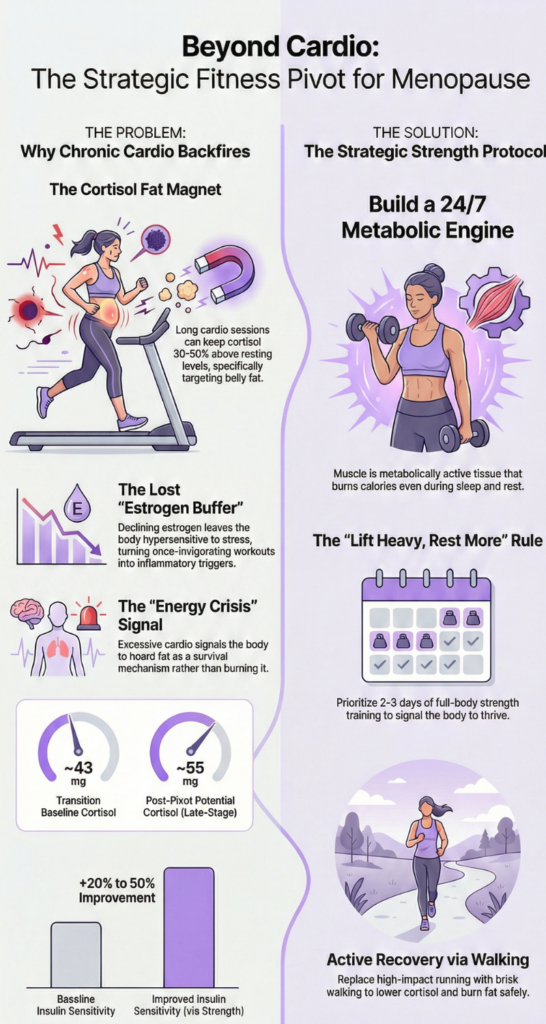
The Energy Crisis Signal
Think of your body’s energy reserves like a bank account. In your 20s and early 30s, you had a high overdraft limit; you could spend energy on long runs, recover quickly, and bounce back the next day. In midlife, that overdraft limit shrinks significantly.
When you perform excessive cardio without adequate recovery, your body perceives an “energy crisis.” Instead of burning fat, it hoards it as a survival mechanism. This is why pushing harder often leads to diminishing returns. You are working harder for less profit.
The ROI of Exercise Has Changed
Using the same high-volume cardio strategy during perimenopause is like continuing to invest in a stock that has crashed. The market conditions—your hormones—have shifted.
Continuing to pour effort into a strategy that ignores your current biological reality is an inefficient use of your limited energy. We need to look at your perimenopause fitness strategy through the lens of Return on Investment (ROI). Right now, long cardio sessions are a high-cost, low-yield investment.
The Cortisol Connection: How Chronic Cardio Triggers Menopause Belly Fat Exercise is Stress (Literally)
Biologically, your body does not distinguish between running from a tiger and running on a treadmill. Both elevate cortisol, the primary stress hormone. A temporary spike is normal and necessary, as it mobilizes fuel for the workout.
However, long or frequent sessions can keep cortisol elevated by 30-50% above resting levels. When this stress becomes chronic, it creates a biochemical environment that heavily favors fat storage. According to recent data discussed by Train Forever Strong (Source 6), when these demanding workouts happen too often without recovery, cortisol remains chronically high, signaling your body to hold onto energy reserves.
The Belly Fat Mechanism
Here is the specific link to menopause belly fat: Chronically high cortisol specifically targets visceral fat tissue in the abdomen. Unlike subcutaneous fat (the kind you can pinch), visceral fat is deep within the torso.
This deep belly fat has four times as many cortisol receptors as fat elsewhere in the body, making it a magnet for stress-induced weight gain. Furthermore, elevated cortisol triggers ghrelin (the hunger hormone), making you crave quick energy like sugar and refined carbs. Your cardio routine might be physically burning calories, but hormonally, it is driving you to eat them back.
The Missing Buffer: Why Estrogen Decline Changes the Rules
Estrogen as the Corporate Moderator
During your reproductive years, estrogen acted as a powerful “corporate moderator” in your body. It buffered cortisol’s effects and helped regulate insulin sensitivity. It kept the stress response in check, ensuring that a hard workout didn’t send your system into panic mode.
The Post-Buffer Reality
As cited in recent research from the *National Library of Medicine* (Source 14), as estrogen creates a “buffer” deficit, your body becomes hypersensitive to stress. Without this hormonal protection, a workout that used to feel invigorating now feels draining and inflammatory.
Data indicate that cortisol levels naturally rise during the transition to late-stage menopause. According to studies highlighted by *Train Forever Strong* (Source 6), cortisol can rise from roughly 43 mg to nearly 55 mg during this transition. Adding the stress of endurance training to this natural rise creates a “perfect storm” for inflammation and cortisol weight gain.
The Strategic Pivot: Why Strength Training is Your New ROI
Building a Metabolic Engine
If cardio is a cash payment, muscle is a high-yield savings account. Muscle tissue is metabolically active, burning calories even when you are sitting still or sleeping.
Since muscle mass naturally declines after 40, strength training is the only way to reverse this trend. You are not just building strength; you are building a metabolic engine that runs 24/7.
Improving Insulin Sensitivity
Resistance training does what cardio often cannot: it drastically improves how your body handles sugar. This is vital because insulin resistance is a key driver of midsection weight gain.
According to a study published in *PubMed Central* (Source 25), resistance training can improve insulin sensitivity by 20-50% in postmenopausal women. This helps shuttle glucose into muscles for fuel rather than storing it as fat on your waistline. This is one of the most effective levers we can pull for hormonal weight loss.
Bone Health Insurance
Beyond aesthetics, strength training provides critical protection for your skeleton. As estrogen levels decline, increasing osteoporosis risk, lifting weights provides the mechanical stress necessary to maintain bone density in the hip and spine. It is a long-term investment in your mobility and independence.
Your New Operating System: A Smarter, Not Harder Fitness Protocol
The Foundation: Lift Heavy, Rest More
Shift your focus from burning calories to building tissue. Aim for 2-3 days of full-body strength training. This signals your body to thrive, not just survive.
You do not need to spend hours in the gym. Focused, deliberate movements that fatigue the muscle are what stimulate change.
The Base: Walking and Low-Impact Movement
Replace the pounding pavement with brisk walking. Walking lowers cortisol and improves mood without taxing your adrenals.
It is the perfect active recovery tool to combat menopause belly fat. Aim for a pace where you can talk, but not sing. This keeps you in a fat-burning zone without triggering a stress response.
The Balancer: Mind-Body Practices
Integrate yoga, Tai Chi, or Pilates to activate the parasympathetic nervous system (the rest-and-digest response). This actively lowers the stress load, signaling safety to your body so it feels safe enough to release stored fat.
Stop Fighting Your Physiology
It is time to resign from the war against your body. The frustration you feel is valid, but the solution is not to push harder—it is to pivot strategically.
By trading chronic cardio for strength training for women over 40 and active recovery, you align your actions with your new hormonal reality. You are not giving up; you are leveling up your strategy. Trust that your body wants to heal and balance itself; you just need to give it the right instructions.
Frequently Asked Questions
No. While you may burn fewer calories during the actual workout session, strength training increases your metabolic rate over the long term. By lowering cortisol, you also stop the hormonal signaling that encourages fat storage. This shift often leads to a leaner physique despite less “sweat equity” because you are finally working with your hormones rather than against them.
Treat HIIT like a strong spice—use it sparingly. Limit these sessions to 1-2 times per week, and only on days when you feel fully rested and low-stress. If you are exhausted, swap HIIT for a walk; your hormones will thank you. Excessive HIIT can mimic the cortisol spike of long cardio if not managed carefully.
This is a common myth. Women generally lack the testosterone levels required to build massive bulk. Instead, strength training will create a firmer, more defined silhouette. It helps tighten the areas that feel softer due to hormonal changes, giving you a “toned” look rather than a bulky one.
Yes. Brisk walking is excellent for cardiovascular health and does not come with the cortisol spike associated with prolonged running. It improves circulation, lowers blood pressure, and aids in mental clarity without draining your energy reserves. It is a sustainable way to maintain heart health through perimenopause and beyond.
Consistency is key. You may feel increased energy and better sleep within two weeks. Visible changes in body composition, such as increased muscle definition and reduced menopause belly fat, typically become noticeable after 8-12 weeks of consistent training and proper nutrition.
*Research Note: Information in this article regarding cortisol levels, estrogen buffering, and insulin sensitivity supports findings from the National Library of Medicine (PMC articles 8555925, 11465887, 10306117) and reporting from KIRO 7 and Train Forever Strong.*