

The Difference Between Strength Training and Building Muscle Mass
Have you ever walked out of the gym feeling pumped, only to throw your back out picking up a laundry basket two hours later? It is a frustrating paradox that many professional women face. You are diligent with your workouts, scheduling them between meetings and family obligations, yet your body doesn’t seem to translate that gym effort into real-world resilience.
We need to have a candid conversation about how you are investing your physical energy. You treat your finances and your career with strategic oversight; your physiology requires the same level of executive planning.
At this stage of life, exercise isn’t just about calorie burn or aesthetics; it is about building a physiological armor that serves you outside the weight room. This is the heart of Functional Training 101. It is the difference between looking strong and actually possessing the capability to navigate your world with ease.
The Core Distinction: Functional Strength vs. Hypertrophy
Defining Hypertrophy: The Architecture of Size
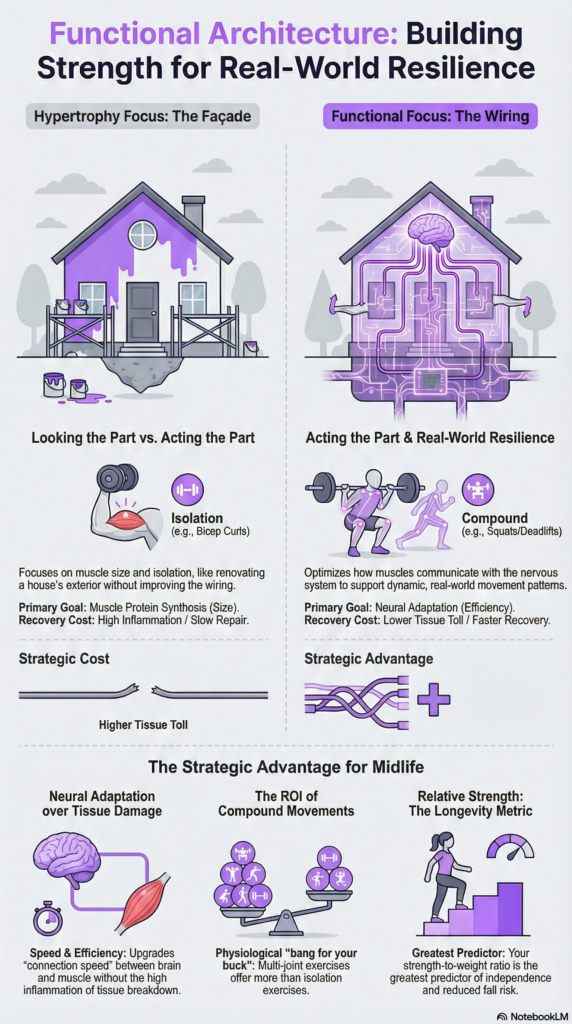
Think of hypertrophy as renovating the façade of a house. It is focused on muscle protein synthesis—repairing and growing muscle fibers to increase physical size. In the gym, this looks like isolating specific muscles to exhaust them, forcing them to grow larger during recovery.
While this has aesthetic benefits and certainly increases metabolic demand, it doesn’t always guarantee the house has good wiring. You can have impressive definition in your arms but still lack the stability to lift a heavy suitcase into an overhead bin without straining your shoulder.
Defining Functional Strength: The Wiring of the House
Functional training is the electrical upgrade. It focuses on how your muscles communicate with your nervous system and support your skeletal structure during dynamic movement. It isn’t just about how much you can lift; it is about how well you can handle the load of your daily life.
When we discuss Functional Strength vs Hypertrophy, we are distinguishing between looking the part and acting the part. Functional training prioritizes movement patterns—pushing, pulling, twisting, and bending—rather than individual muscle groups. It ensures that when you move, your body fires in a coordinated, safe, and powerful sequence.
Functional Training 101: The Science Under the Surface
Muscle Protein Synthesis vs. Neural Adaptation
To understand why your training needs to shift, we must look at the biological cost. When you train for size (hypertrophy), you are intentionally damaging muscle fibers to force repair. It is a high-resource process involving significant inflammation and energy to rebuild tissue.
Functional strength, conversely, targets neural adaptation. It teaches your brain to recruit more muscle fibers simultaneously and fire them faster. It is like upgrading your internet connection speed rather than just buying a bigger computer monitor.
Recent data in exercise physiology highlights the distinction between neural adaptation vs muscle growth. Neural adaptation creates strength gains by improving the efficiency of the signal between your brain and your muscles, often without the heavy toll of tissue breakdown that leads to extreme soreness.
The Efficiency of the Nervous System
For the midlife woman, neural efficiency is crucial. As hormones shift, specifically the decline in estrogen and progesterone, our recovery times from heavy tissue damage slow down. We simply do not bounce back as quickly as we did in our twenties.
Focusing on neural adaptations allows you to get stronger without constantly keeping your body in a state of high inflammation and repair. It is a smarter, more efficient way to train that respects your current hormonal reality while still delivering power.
Why Compound Movements Are Your Strategic Advantage
The ROI of Multi-Joint Exercises
Time is likely your scarcest resource. Isolation exercises (like bicep curls or leg extensions) are like replying to emails one by one. It is slow, tedious, and the impact is siloed.
Compound movements (like squats, lunges, or deadlifts) are like hitting “Reply All” to resolve the issue instantly. Functional training relies on these compound movements to engage multiple muscle groups and joints simultaneously.
Compound movements for women are particularly vital because they stimulate a greater neuroendocrine response. This means they do a better job of helping to regulate hormones and maintain bone density than isolation exercises do. You get more physiological “bang for your buck” with every repetition.
Translating Gym Gains to Grocery Bags
We train to live, not live to train. By focusing on functional patterns, you ensure that carrying luggage, moving furniture, or playing with children doesn’t result in injury.
This is where the rubber meets the road. If your gym routine involves sitting on a machine and pushing a lever, your body isn’t learning how to stabilize itself in a chaotic environment. Functional training connects the dots between the barbell and the boardroom of your life, ensuring you have the stability to stand tall in both.
The Metric That Matters: Strength-to-Weight Ratio
Understanding Relative Strength
There is a metric often overlooked in favor of the number on the scale: relative strength. Absolute strength is how much total weight you can move. Relative strength—your strength-to-weight ratio—is how well you can move your own body through space.
As we age, maintaining a high strength-to-weight ratio is the greatest predictor of longevity and independence. It ensures you remain the pilot of your own vessel, capable of navigating obstacles without assistance.
The strength-to-weight ratio benefits are profound. Research consistently suggests that the ability to mobilize one’s own body weight is directly correlated with reduced fall risk and increased functional independence in later years. It is about mastery over your own physical domain.
Joint Health and Longevity
Building excessive mass without the requisite functional control can place undue stress on joints that are already navigating lower estrogen levels. Estrogen acts as a hydration agent for our joints; as it depletes, we become more prone to stiffness and injury.
Functional training prioritizes stability and range of motion through full movement patterns. By training movements rather than muscles, you teach your joints to absorb and distribute force evenly. It acts as a lubricant for your joints rather than a grinder, preserving your mobility for the long haul.
Implementing a Functional Strategy Without Burnout
Shifting Your Mental Framework
You do not need to choose one exclusively, but the ratio must shift. Think of hypertrophy as your savings account—it accumulates value over a long time but isn’t always immediately accessible. Think of functional training as your checking account.
You need liquid assets to handle daily transactions. Functional training provides that liquidity. It gives you the immediate, accessible strength to handle whatever demand the day places on you, whether that is a marathon meeting or a literal marathon.
The 80/20 Rule for Midlife Training
So, how do you apply these Functional Training 101 principles? Dedicate 80% of your routine to functional, compound movements that challenge your stability and strength. This includes free weights, suspension training, and bodyweight movements that require you to balance.
Reserve the remaining 20% for hypertrophy work to target specific weak points or aesthetic goals. If you love doing bicep curls because they make you feel confident in sleeveless tops, keep them. But view them as the garnish, not the main course. This is the strategic balance that respects your physiology and maximizes your time.
Research Note: The distinctions regarding neural adaptation versus muscle hypertrophy and the benefits of compound movements referenced in this article are supported by general findings in exercise physiology and recent literature on sarcopenia prevention and resistance training for aging populations.
Download our free E-book “The Fog Lift: Reclaiming your energy and clarity after 40.”
Frequently Asked Questions
No. Bulk generally comes from a specific type of hypertrophy training combined with a massive calorie surplus. Functional training focuses on neural density—making the muscle harder and more efficient—rather than significantly larger. You will look toned and athletic, but not bulky.
CrossFit and HIIT are methodologies that often use functional movements, but they prioritize intensity and speed. Functional training is the foundational discipline of moving correctly. You can do functional training slowly and deliberately without the high-intensity aspect that can sometimes spike cortisol levels in midlife women.
Absolutely. In fact, they can complement each other. Using functional movements as your primary lifts (squats, presses) and following up with hypertrophy isolation work for stability (like glute bridges or tricep extensions) is an excellent strategy. This is often called “powerbuilding,” but for our purposes, it is simply comprehensive maintenance.
Generally, yes, and it is often the cure. Chronic lower back pain frequently stems from a weak core or glutes that aren’t firing correctly. Functional training teaches these muscles to work together to brace your spine. However, always consult with a physical therapist to ensure your form is correct before adding load.
Menopause changes the timeline, not the possibility. Lower estrogen means slower collagen synthesis and muscle repair. However, your nervous system remains highly plastic. You can absolutely build strength during menopause; you just need to prioritize recovery and form more than you did in your thirties.