
How to Master Your Metabolism and Reclaim Your Rest
Have you ever stood in front of your open refrigerator at 3:00 AM, fantasizing about curling up next to the cold milk just to find relief? You are not the only one staring into the abyss of the appliance light while the rest of the house sleeps.
For many professional women, the heat and wakefulness of this transition feel like an endurance sport they never signed up for. You spend your days managing high-stakes decisions and caring for others, only to find that your nights have become a battleground.
While the struggle is visceral, the solution requires a strategic shift in perspective. It is time to look beyond basic hormonal fluctuations and address the metabolic and structural changes that are actually keeping you awake. This is not about “fixing” a broken body; it is about providing the high-level management your physiology now demands.
Here is how we move from exhaustion to agency with effective menopause-insomnia solutions that prioritize your long-term health.
The Hidden Link Between Insulin Resistance and Menopause
Why Hormones Are Not the Only Sleep Thief
Did you know that your waking episodes might be metabolic rather than just hormonal? It is easy to blame every sleepless night on dropping estrogen, but often, a shift in metabolism acts as a “silent sleep-thief.”
As we approach midlife, our bodies naturally change how they store energy. Abdominal fat accumulation can increase the risk of insulin resistance. This isn’t just a weight issue; it is a sleep issue.
When your body struggles to regulate blood sugar, your insulin levels remain high. This can trigger excessive thirst and alter how frequently your kidneys filter waste. The result is a physiological urge to wake up.
The Bladder-Blood Sugar Connection
If you find yourself making multiple trips to the bathroom, do not assume it is just aging. It may be your body attempting to regulate glucose.
When blood sugar is unstable, your body tries to flush out the excess, forcing you out of bed multiple times a night. This disrupts your REM cycles and leaves you feeling unrefreshed, even if you were technically in bed for many hours.
Viewing this as a metabolic signal rather than a nuisance allows us to take action. By addressing how we process energy, we can reduce those disruptions and protect long-term health.
Strength Training for Menopause Sleep: The Strategic “Multiplier”
Moving Beyond Cardio
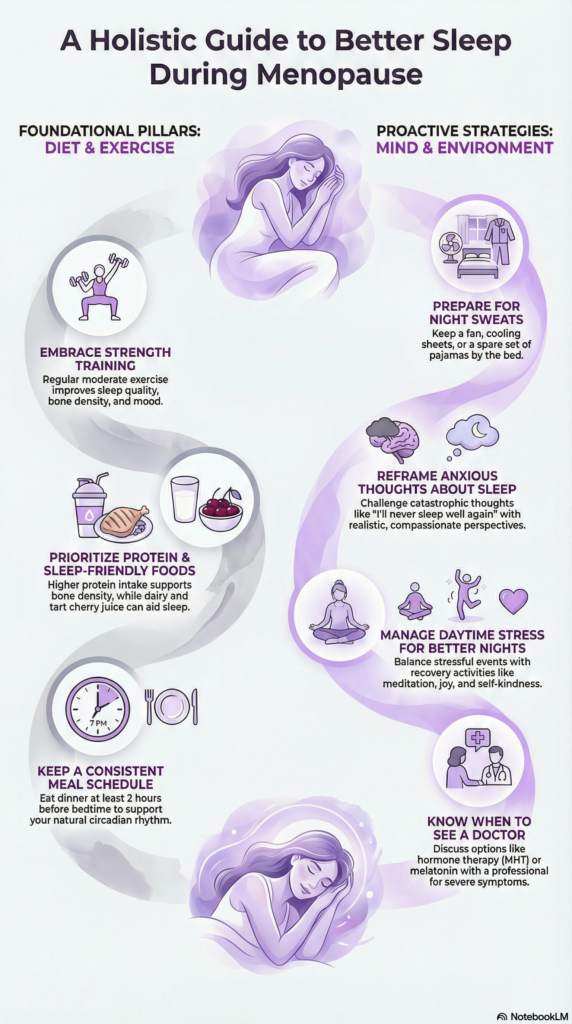
Why is lifting weights often more effective for sleep than hours on the treadmill? Many women have been conditioned to believe that cardio is the only way to manage weight, but for sleep and strength, strength training is the superior tool.
Strength training acts as a physiological “multiplier.” It does not just build muscle; it actively manages the insulin resistance we discussed earlier. Muscle tissue is the body’s largest consumer of glucose.
By increasing your muscle mass, you give your body a bigger “tank” to store blood sugar, preventing the spikes and crashes that wake you up at 2:00 AM.
The Science of “Impact” and Rest
Recent clinical research highlights the profound impact of resistance training. A 12-week study demonstrates that moderate resistance exercise significantly improves sleep quality in perimenopausal women.
It provides a synergistic effect—burning glucose more efficiently so your blood sugar doesn’t wake you up. Furthermore, this type of training is essential for your skeletal health.
Exercise programs combining strength and impact activities protect bone mineral density, a critical concern as estrogen wanes. Think of strength training as a high-yield savings account for your skeleton.
By engaging in this “triple threat” of endurance, strength, and balance, you create a physical outlet for anxiety. This ensures that when your head hits the pillow, your body is physically primed for recovery, not just mentally exhausted.
The Melatonin and Protein Protocol: Fueling Adaptation
Melatonin for Menopause and Natural Sources
Are you giving your body the building materials it needs to stay asleep? We often think of sleep as an “off switch,” but it is actually an active chemical process that requires fuel.
Research supports the use of nutritional interventions to stabilize the sleep-wake cycle. For example, tart cherry juice promotes natural melatonin levels, offering a modest but measurable improvement in sleep duration and quality.
For those needing extra support, discussing 2mg of prolonged-release melatonin with a doctor can be a strategic move. This formulation mimics the body’s natural release, helping to regulate circadian rhythms without the grogginess associated with heavy sedatives.
Protein: The Foundation of Recovery
If you are putting in the work to lift weights, you must fuel the repair process. Recovery is where the magic happens, and protein is the currency of recovery.
Tryptophan-rich foods like dairy and animal protein support the brain’s “feel-good” chemicals, specifically serotonin, which is a precursor to melatonin.
For women navigating weight changes, aiming for 1–1.2 grams of protein per kilogram of body weight is the sweet spot. This intake supports muscle recovery and bone health, ensuring your metabolic engine runs smoothly through the night.
Think of protein as the scaffolding that holds your sleep architecture together. Without it, the body struggles to repair the wear and tear of the day, leading to restless, shallow sleep.
Breaking the Anxiety Loop: Using CBT-I for Hot Flashes
The Danger of “Sleep Anxiety”
Do you lie awake predicting how terrible tomorrow will be if you don’t fall asleep *right now*? This is “sleep anxiety,” and it creates a vicious circle where the fear of insomnia keeps you awake.
Night sweats trigger the wake-up, but the anxiety prevents the return to sleep. You might find yourself acting like a “fortune-teller,” convinced that a bad night equals a disastrous career day.
You might think, “If I don’t sleep now, I will blow that presentation,” or “I’ll never feel normal again.” These absolutes ramp up your cortisol, making sleep biologically impossible.
Cognitive Reframing Techniques
Cognitive Behavioral Therapy for Insomnia (CBT-I) offers a way out. It is the gold standard for treating insomnia because it addresses the software (your thoughts) rather than just the hardware (your body).
Instead of spiraling into “all-or-nothing” thinking, practice reframing. When you wake up, try to catch the catastrophic thought.
Tell yourself: “I am resting. Even if I am not sleeping, my body is safe and relaxing.” This compassionate logic calms the nervous system. It lowers the cortisol spikes that fight against sleep and signals to your brain that you are safe, increasing the likelihood of drifting back off.
Practical Menopause Insomnia Solutions and the “Jug” Theory
Managing Your Energy “Jug”
I often tell my clients to think of their energy like a jug. Stress, work, family obligations, and hot flashes drain the jug throughout the day.
To sleep well, you cannot just crash with an empty jug; you must actively refill it with recovery moments before the sun goes down. This isn’t about adding more to your to-do list; it is about micro-restoration.
Incorporating Tai Chi, yoga, or a brief meditation can alleviate hot flashes and mood swings. These practices help “fill your jug,” reducing the sympathetic nervous system overdrive that keeps you wired at night.
Cooling Hacks for Immediate Relief
When the heat hits, you need tactical solutions, not just willpower. The physiological heat of a hot flash is intense, and preparation is your best defense.
The 2-Hour Rule
Finish dinner at least two hours before bed. Digestion requires energy and creates internal heat—essentially a “traffic jam” in your gut that raises your core temperature. Giving your body time to digest helps your core temperature drop, signaling sleep.
The Spare PJ Strategy
Keep a fresh set of sleepwear or a towel within arm’s reach of the bed. If you wake up soaked, changing without fully waking up prevents your brain from turning on its “alert mode.” You stay in the dark, you stay quiet, and you stay closer to sleep.
Moisture Management
Invest in wicking sheets and cooling pads. Treat your sleep environment like a high-performance recovery zone. Fans also provide cooling air and act as sound machines, blocking external disruptions.
Your Struggle is Your Superpower
It is easy to view menopause as a “slippery slope to doom,” but I encourage you to look at your nighttime worries through a lens of self-compassion.
When you lie awake worrying about your children, your aging parents, or your career, remember that these worries are reflections of your core values. They show that you are someone who cares deeply and is a person others depend on.
You aren’t “broken”; you are a human navigating a major transition. Shifting your mindset from isolation to a sense of “common humanity”—realizing millions of women are staring at the ceiling with you—can activate your calming nervous system.
The Next Adventure
Reclaiming your sleep requires a holistic map: supporting your metabolism through movement, fueling with the right proteins for adaptation, and reframing your mental approach to the night.
Menopause is not an ending or a problem to be “fixed”—it is a hard-won transition. By implementing these strategies, you aren’t just surviving the night; you are preparing your body and mind for the next adventure.
You’ve made it this far, and that is a victory. What will you do with the energy you reclaim?
Research Note:
*Data and findings referenced in this article regarding exercise, insulin resistance, and sleep quality are supported by clinical research published by TaraMD, and the National Institutes of Health (NCBI/PMC).*
Download our free E-book “The Fog Lift: Reclaiming your energy and clarity after 40.
FAQ: Navigating Your Sleep Strategy
Most research, including the 12-week studies cited, suggests that consistent resistance training yields noticeable sleep benefits within 3 to 4 months. As your muscle mass increases and metabolic markers stabilize, your ability to regulate glucose overnight improves, leading to fewer interruptions.
While generally considered safe, melatonin can interact with blood thinners and diabetes medications. Because metabolism shifts during menopause, your body may process supplements differently. Always consult your physician before starting a new supplement protocol to ensure safety.
Yes. While CBT-I cannot stop the hot flash from happening, it is highly effective at reducing the distress and wake time *after* the flash. It helps you avoid the “anxiety spiral,” allowing you to fall back asleep faster rather than lying awake in frustration.
Morning or afternoon is ideal. Heavy resistance training too close to bedtime (within 3 hours) can elevate cortisol and core temperature. Since your body needs to cool down to sleep, late-night heavy training may delay sleep onset.
Unstable blood sugar can cause a drop in glucose overnight (hypoglycemia). This triggers a survival mechanism where your body releases adrenaline and cortisol to bring sugar levels back up. This chemical surge wakes you up instantly, often accompanied by a racing heart or sweating.