Why Strength Training Feels Different During Perimenopause
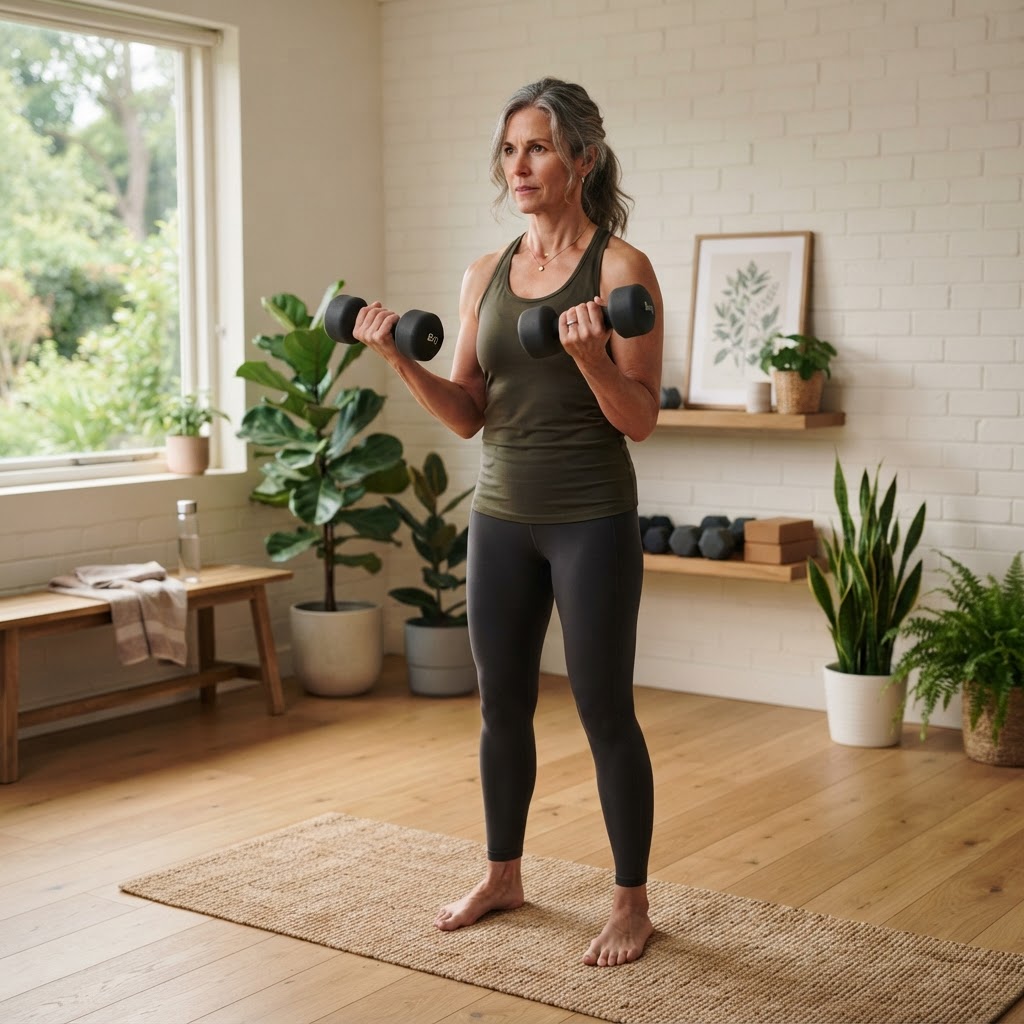
Perimenopause can change how some women experience strength training and recovery — but hormones are only part of the picture. Here's what the research actually says, and how to train thoughtfully through it.
You Used to Bounce Back. Now You Don't.
You've been lifting for years — or you finally committed to starting. Either way, you expected it to feel challenging. What you didn't expect was to feel wrecked for three days after a session that wouldn't have touched you two years ago.
Maybe you're sleeping worse. Maybe you're sore in a way that feels out of proportion. Maybe you finish a workout feeling fine and wake up the next morning completely flat.
You haven't suddenly gotten weaker or less capable. But something has shifted — and it's worth understanding what might be happening, what the research actually says, and what you can do about it.
The Short Answer
Strength training during perimenopause can feel different for some women — and recovery may take more intentional management than it used to. But this doesn't mean you should train less or avoid challenge. It means paying closer attention to recovery as part of your training, not as an afterthought.
The research specifically on perimenopause is limited. Much of what we know comes from postmenopausal studies, which don't automatically apply to women who are still in hormonal transition. That matters, and we'll come back to it.
Why Strength Training Can Feel Different During Perimenopause
Several things may be changing at once — and not all of them are hormonal.
Hormone levels during perimenopause fluctuate in ways that can affect sleep, energy, mood, and how the body responds to physical stress. Progesterone levels can drop and fluctuate, which is associated with disrupted sleep in some women. And disrupted sleep affects recovery from exercise in ways that have nothing to do with the workout itself.
Estrogen decline is also associated with changes in muscle mass and function, based on research in postmenopausal women. Whether and how this plays out during the perimenopausal transition — when hormone levels are fluctuating rather than consistently low — is less well understood. Some women notice changes in how they build and maintain muscle. Others don't.
It's also worth naming the non-hormonal factors: life demands often peak in midlife, nutrition may be inconsistent, training volume or frequency may have increased, or recovery practices may have quietly dropped off. Any one of these can make workouts feel harder to recover from.
What the Research Actually Tells Us
Here's an honest summary of where the evidence stands — and where the gaps are.
Strength training is worth doing. A 2023 systematic review and meta-analysis found that resistance training improves functional capacity and bone mineral density in postmenopausal women. That's meaningful. The certainty of evidence was rated very low to low due to risk of bias in the included studies, so we hold these findings with appropriate care — but the direction is consistently positive.
For bone health, intensity matters. ACSM guidelines recommend heavy resistance training — around 80–85% of 1RM — for improving bone density in perimenopausal women. Low-intensity training doesn't have the same evidence base for this outcome. If bone health is one of your goals, that's important to know.
Anabolic resistance may be a factor. Research in postmenopausal women suggests the body may become less efficient at building muscle in response to training — a concept called anabolic resistance. Some researchers suggest that higher protein intake may help offset this. However, the specific thresholds are often extrapolated from postmenopausal data, and we don't yet have clear, direct evidence for perimenopausal women.
Direct perimenopause research is limited. This is the honest truth: most studies have been conducted in postmenopausal women, and their findings shouldn't be automatically generalized to women who are still in transition. Research is catching up — a 2025 University of Exeter study represents one of the first of its kind specifically in this population, and a 2025 BMJ Open feasibility trial is examining high-intensity resistance training in this group — but the longitudinal data we need simply doesn't exist yet.
What this means for you: we're making informed decisions with incomplete information. That's not a reason to avoid training — it's a reason to train thoughtfully and pay attention to your own response.
Hormones Are Only Part of the Picture
It's tempting to attribute every hard workout and slow recovery to hormones. Sometimes that framing is accurate. Often it's incomplete.
Recovery from strength training is shaped by many things: sleep quality and quantity, protein and overall calorie intake, training volume and intensity, how many sessions you're doing per week, stress load, age, training history, and individual health status. All of these interact.
If you're recovering poorly from training, it's worth asking which of these factors might be contributing — not just assuming it's perimenopause. Sometimes the answer is simpler than you think: you're under-eating, you're under-sleeping, or you've added too much volume too quickly.
This matters because different causes call for different solutions. If it's sleep, adding a rest day won't fix it. If it's nutrition, training less won't fix it either.
What Recovery Really Means
Recovery isn't just about whether your muscles are sore. It's about whether your body — and your nervous system — has had enough time and resources to adapt to the training stimulus before you ask it to do it again.
A useful way to check in with yourself: how did you feel during the session? How do you feel later that same day? And how do you feel the following morning?
These are observation points, not diagnostic tools. You're not trying to diagnose yourself — you're building a picture of how your body is responding over time. A session that leaves you tired but functional is different from one that leaves you unable to concentrate, irritable, or unable to lift your arms the next day.
Noticing these patterns gives you something to work with. It's information, not failure.
Does This Mean You Should Train Less?
Not necessarily — and for many women, training less would be the wrong move.
The evidence base for strength training in midlife and beyond — including for bone density, muscle function, and overall physical capacity — is strong enough that pulling back significantly would mean giving up real benefits. The goal isn't to avoid challenge. It's to apply an appropriate training dose and support recovery well enough that the challenge produces adaptation.
Some women in perimenopause may find they need more recovery time between sessions than they used to. Others may find their response is largely unchanged. There's genuine individual variation here, and the research doesn't support one-size-fits-all guidance.
What the evidence and good coaching practice both suggest: how you train matters, and recovery isn't optional.
What "Manageable" Strength Training Looks Like
"Manageable" doesn't mean easy. It doesn't mean never feeling sore. And it doesn't mean avoiding challenge.
It means finding a training dose that still provides a meaningful stimulus — but doesn't repeatedly leave you so depleted that you can't recover adequately before your next planned session.
Several variables shape this:
- Volume — how many sets and reps per session and per week
- Intensity — how heavy or how close to maximum effort you're working
- Exercise selection — compound movements are efficient but also more demanding; balance is worth thinking about
- Rest periods — shorter rest increases metabolic demand; longer rest supports heavier lifting
- Frequency — how many sessions per week, and how they're spaced
There's no universal number that works for every woman. What's manageable for someone who's been lifting for ten years is different from someone who started six months ago. What's manageable at one point in your cycle or one week in your life may be different from another.
The principle is this: keep training. Keep challenging yourself. And build enough recovery infrastructure — sleep, protein, rest days, session spacing — that the training can actually do its job.
How to Assess Your Own Recovery Response
You don't need a tracking device to do this. You need consistent observation.
For two to four weeks, pay attention to three things after each session: how you felt during the workout, how you felt that evening, and how you felt the next morning. Note whether soreness or fatigue is interfering with normal function, or whether it's just the ordinary effort of having worked hard.
If you're consistently waking up the morning after a session feeling unable to function normally, that's worth taking seriously. If you feel tired but capable, that's likely normal training fatigue.
Also notice patterns across the week. Are certain session types harder to recover from? Are there weeks where everything feels harder — and can you connect that to sleep, stress, or nutrition?
You're not diagnosing yourself. You're gathering information that helps you make better decisions about how to train.
What to Do If Your Routine Repeatedly Leaves You Depleted
If you're consistently struggling to recover, start with the basics before changing your training program.
Sleep: If sleep is disrupted — a common experience during perimenopause for some women — this is worth addressing directly, whether through sleep hygiene practices or by talking to your doctor. Poor sleep impairs recovery regardless of how well everything else is managed.
Protein: If you're under-eating protein, your muscles don't have the raw material to repair and adapt. While the precise thresholds for perimenopausal women aren't fully established, the general direction in the evidence points toward higher protein intake being beneficial for muscle adaptation in midlife women.
Training load: If sleep and nutrition are reasonable and you're still struggling, look at your training volume and frequency. Sometimes the answer is one fewer session per week, shorter sessions, or reducing volume while maintaining intensity.
Talk to a professional: If fatigue is persistent and significant, it's worth speaking with a GP or sports medicine professional. Not every symptom in perimenopause has a hormonal cause, and ruling out other contributors matters.
Your Practical Next Step
The central message here isn't that perimenopause makes strength training harder or that you should train less. It's that recovery deserves the same attention and intention as the training itself.
You may not need to stop strength training during perimenopause — you may need to train with more respect for recovery, consistency, and what your body is telling you now.
If you're looking for structured support — programming that takes recovery seriously and is built for women in midlife — the Her Next Step member app includes strength training plans designed with these principles in mind.
Her Next Step is a member app, not a medical device. It doesn't diagnose recovery, measure your hormones, or prescribe medical treatment. What it does offer is structured, thoughtful programming and the kind of guidance that helps you stay consistent without repeatedly burning out.
Key Takeaways
- Strength training can feel different during perimenopause for some women — but the reasons are multifactorial, not purely hormonal.
- Most research in this area has been conducted in postmenopausal women. Direct perimenopause evidence is limited and still emerging.
- Estrogen decline is associated with changes in muscle mass and function in postmenopausal research, but individual variation is significant.
- Heavy resistance training (around 80–85% 1RM) has evidence support for bone density; low-intensity training does not have the same evidence base for this goal.
- Recovery is shaped by sleep, nutrition, training load, stress, and life demands — not just hormones.
- "Manageable" training means an appropriate dose that still challenges you, without repeatedly leaving you unable to recover before your next session.
- Pay attention to how you feel during a session, later that day, and the following morning. This is observation, not diagnosis.
- If you're consistently depleted, check sleep and nutrition before assuming the training itself is the problem.
Her Next Step Can Help
Her Next Step is a member app built for women in midlife who want structured strength training with recovery built in — not bolted on as an afterthought.
It's not a medical device. It won't tell you what your hormones are doing. But it will give you a clear, well-considered framework for training consistently, progressing appropriately, and knowing when to push and when to hold back.
👉 View My Plan at Her Next Step
Sources
- American College of Sports Medicine (ACSM). Position stand on exercise and physical activity for older adults. Relevant guidance on resistance training intensity for bone health.
- Maltais ML, Desroches J, Dionne IJ. Changes in muscle mass and strength after menopause. Journal of Musculoskeletal and Neuronal Interactions. 2009;9(4):186–197.
- Systematic review and meta-analysis on resistance training, functional capacity, and bone mineral density in postmenopausal women. 2023. Available via PubMed (PMID: 36283059). (Certainty of evidence rated very low to low due to risk of bias in included trials.)
- University of Exeter. First-of-its-kind study on resistance training and physical function during menopause. 2025. (Emerging research; refer to University of Exeter research communications for full citation.)
- BMJ Open. High-intensity resistance and impact training (HiRIT) feasibility trial in perimenopausal women. 2025. BMJ Open 15(2):e093711. Available at: https://bmjopen.bmj.com/content/15/2/e093711
- Benton MJ, Hutchins AM, Dawes JJ. Effect of menopause on muscle mass, body composition, and functional capacity. Current Nutrition Reports. 2021;10(3):309–319.
This article is for educational purposes only and does not constitute medical advice. Please consult a qualified healthcare professional for guidance specific to your health.
About the Author

Vilmos Bond
Functional Trainer & Wellness Coach · Founder, Wellness Next Step
With over a decade of experience, Vilmos helps women over 40 navigate perimenopause with calm, clarity, and evidence-based strategies. His approach combines functional fitness, hormone education, and lifestyle design to help clients reclaim their energy, sleep, and confidence during one of life's most transformative seasons.
Work With MeStruggling with perimenopause sleep loss?
Get the free 7-Day Sleep Reset delivered straight to your inbox.
Energy, Stress & Daily Wellbeing
Coming August 2026
Perimenopause Through The Husband's Eyes
The Co-Pilot's Handbook
Learn About the Book