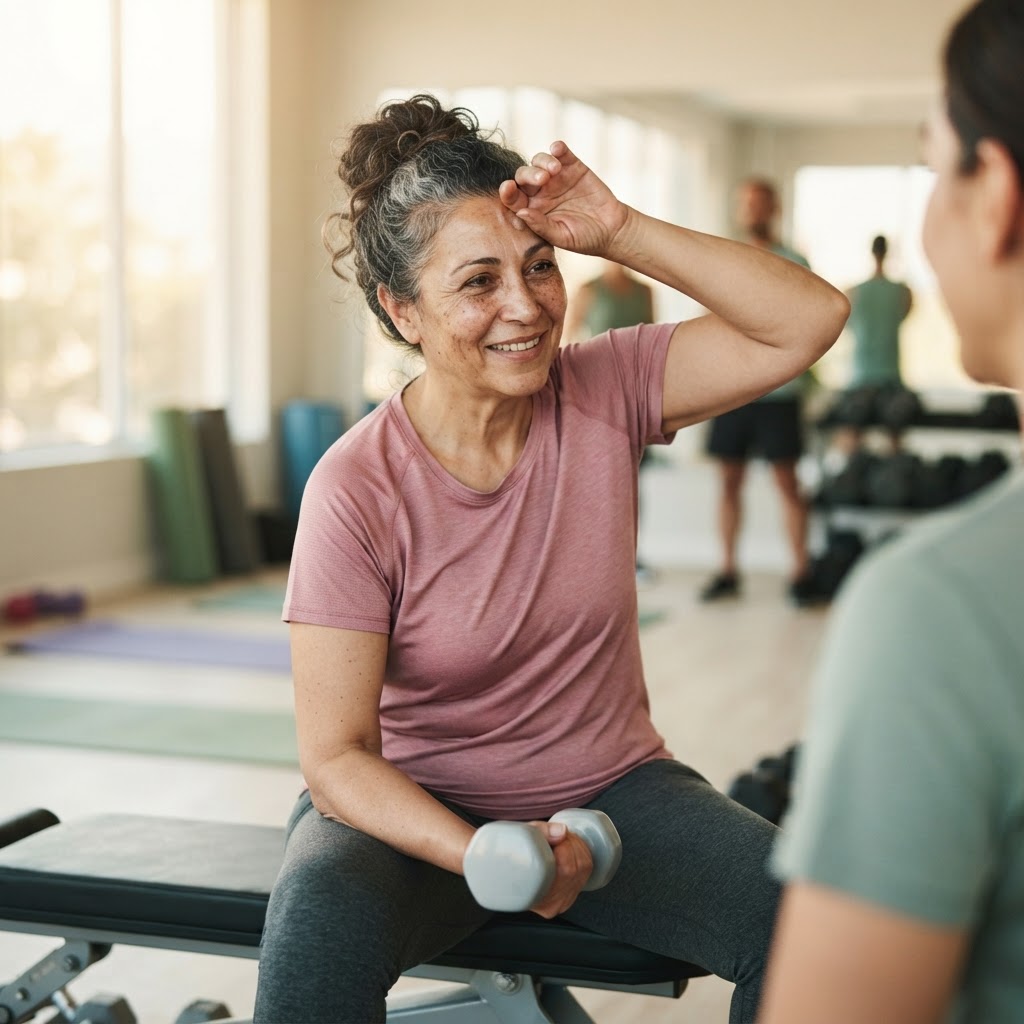
It's Saturday morning, and you're carrying the last two grocery bags up the front steps. Halfway up, you stop. Not because you're out of breath. Because your hands and forearms have quietly voted to put the bags down.
Once, you'd have carried every bag in one trip without a thought. Now there's a thought. And underneath it, a question you may not have said out loud: is this just how it goes from here?
Maybe someone told you lifting is for younger women. Maybe you're just tired of fitness advice that changes every month.
You're not imagining it, and you're not late
Noticing that everyday lifting feels harder is common in this season. It's also measurable: researchers test it rather than just asking.
I'm Vilmos, a wellness coach. I work with women in perimenopause and menopause on sleep, strength, energy, and stress, with small, realistic steps. I'm a wellness coach, not a medical professional — this is education, not medical advice.
So this week, one question: if you're past menopause, is strength training still worth starting? We're going to read what the research actually says. Together, in plain English.
What the research actually says
The study is a 2024 review in the journal Climacteric, by González-Gálvez, Moreno-Torres and Vaquero-Cristóbal. It's a systematic review with meta-analysis. In plain English: instead of running one new trial, the researchers searched three large research databases (PubMed, Web of Science and EBSCO) for every trial that fit their question, then pooled the results.
Think of how a navigation app decides there's traffic ahead. It doesn't trust one driver. It pools what many phones report and shows the pattern. A meta-analysis does that with trials, which is why a pooled answer usually deserves more weight than any single study.
They found 12 trials. All were randomized controlled trials, meaning women were assigned to strength training or to a comparison group by chance, not by choosing for themselves. All of them studied healthy postmenopausal women. Two blinded investigators handled the selection and quality checks, and the review was registered in advance.
The abstract doesn't report how many women took part, their ages, how postmenopause was defined, or what the training programs looked like. I'll come back to that.
Here's the picture I want you to hold onto. Strength works like a retirement account. Each session is a deposit. One deposit barely shows. Regular deposits, made in ordinary weeks, add up, and you're building the account for the woman you'll be later, not for this Saturday.
In these 12 trials, the women in the training groups were making deposits. The comparison groups weren't. So the review's question is really this: at the end, did the two accounts look different?
What it found, and what it didn't
They did. Compared with the control groups, women who did resistance training became significantly stronger in their lower body and significantly stronger in their upper body. Their aerobic fitness, measured as maximal oxygen uptake (how much oxygen the body can use at full effort), was significantly better too. All three results were statistically strong (p < 0.001, meaning very unlikely to be chance).
One honesty note about size. The review reports these results as standardized scores, and they are unusually large. So I read them as "clearly stronger," not as a precise amount, and I won't turn them into a "times stronger" headline.
Now the other half, in the same size type. On bone mineral density, the authors say there is "more debate." The same goes for body measurements such as weight, waist and BMI. So this review does not show clear changes in bone density or body measurements, and the specific numbers for those outcomes aren't reported in the abstract.
If someone promised you lifting would change your bones or your waistline, this review doesn't back that up. It backs up strength and fitness.
What this study can't tell us
Who wasn't in it. Only healthy postmenopausal women were studied. Nothing here is about perimenopause, and nothing is about women living with health conditions. If you're in perimenopause, read this as encouraging context, not evidence about you.
How precise the numbers are. Confidence intervals, how much the trials disagreed with each other, and the risk-of-bias ratings are not reported in the abstract. Neither is the total number of women. And 12 trials is a modest base.
Which program. Exercise types, frequency, intensity and program length are not reported. The authors suggest 3 days a week of 60-minute sessions as a starting point, but that's their recommendation. The trials didn't compare it against smaller or larger amounts.
What it means for your day. The outcomes were fitness and strength tests. Quality of life, energy and daily function weren't reported as measured outcomes, even though the conclusion links strength to quality of life.
This is where the retirement account picture reaches its edge. The review shows the balance grew. It doesn't print the deposit schedule that grew it, and it doesn't show what the account buys you on an ordinary Tuesday.
The lifestyle translation
Back to the account. You don't need the perfect plan. You need deposits small enough that you'll keep making them.
Three things worth testing, gently, this week:
- Make the deposit small and regular. Two short sessions you'll actually do beat one heroic one you dread. Chair sit-to-stands and wall push-ups need no equipment at all.
- Attach it to something you already do. While the kettle heats. Before the evening news.
- Notice one everyday sign. Not a mirror. The grocery bags, the suitcase, the stairs. Write down what you notice.
And about the authors' 3 days of 60 minutes: hold it as a direction, not a starting line. If two short sessions are what fit your week, those are real deposits.
One experiment for the week
Pick two days now and write them down. On each, do a short, slow session of chair sit-to-stands and wall push-ups. Afterwards, write one line: how many chair stands felt steady.
That's it. An experiment you run on yourself, with a pencil. And if you miss a day, nothing breaks. Rhythm, not streaks.
When to talk to a clinician
If you live with a health condition, have pain or a past injury, or haven't been active in a long time, please take that seriously and talk with your own clinician before you start. This review only studied healthy women. A coach can help you build the habit. Checking whether a plan suits your body is a different job, and knowing the difference is part of doing this honestly.
The account is still open
In these 12 trials, women past menopause made deposits, and their strength grew. Your account isn't closed. The next deposit can be a small one.
If this felt a little too familiar, stick around. We're figuring this stuff out together.
Your next step. This is why I built the Exercise Library in Her Next Step: exercises match the equipment you actually have and the way your body moves, and there's a button for "this doesn't feel right." If you'd like to try it before launch, become a founding member at wellnessnextstep.com/founding. It's free until January 15, 2027, with no card needed and no auto-charge. Founding members are asked to use the app 3–4 times a week and answer a short weekly survey. Register by Tuesday at midnight (New York time) and you're in this Friday.
Sources
- González-Gálvez N, Moreno-Torres JM, Vaquero-Cristóbal R. Resistance training effects on healthy postmenopausal women: a systematic review with meta-analysis. Climacteric. 2024 Jun;27(3):296-304. Epub 2024 Feb 14. PMID: 38353251. DOI: 10.1080/13697137.2024.2310521.